“And I would go down almost without thinking how extraordinary it was that I should be calling upon that mysterious Mme de Guermantes of my boyhood simply in order to make use of her for a practical purpose, as one makes use of the telephone, a supernatural instrument before whose miracles we used to stand amazed, and which we now employ without giving a thought, to summon our tailor or to order an ice cream.”
Marcel Proust
In Search of Lost Time
Volume V: The Captive, The Fugitive
Light bulbs, the telephone, photography. Automobiles, television, airplanes. Computers, the Internet, cell phones. New technology emerges and disrupts the world with an otherworldly and supernatural air of mystery. There is something beautiful in this disruption–a spark of renewal in the world as we all stand at the edge of possibility. Innovation makes the world feel alive.
But, following the Technology Adoption Curve, new tech is picked up by the innovators, the early adopters, and the early majorities. Then the late majorities and the laggards glom on and what was once magic becomes mundane and the world slips back into the status quo and, in a way, dies. Or at least drifts back into a that catatonic state induced by “the analgesic effect of habit.”
“As a rule it is with our being reduced to a minimum that we live; most of our faculties lie dormant because they can rely upon Habit, which knows what there is to be done and has no need of their services. But on this morning of travel, the interruption of the routine of my existence, the unfamiliar place and time, had made their presence indispensable. My habits, which were sedentary and not matutinal, for once were missing, and all my faculties came hurrying to take their place, vying with one another in their zeal, rising, each of them, like waves, to the same unaccustomed level, from the basest to the most exalted, from breath, appetite, the circulation of my blood to receptivity and imagination.”
Volume II: Within a Budding Grove

Marcel Proust explores cycles of wonder and disinterest, joy and monotony, life and death throughout his masterpiece, À la recherche du temps perdu (In Search of Lost Time). In the novel, Proust’s narrator first learns to experience and interpret the world, then watches as it calcifies around him; the people and things that once brought him moments of pleasure are lost to the artifice of habit. We experience it all the time: Laughing at the same sitcom trope that has been trotted out for decades. We experience this every year when a new iPhone hits the market: there’s a moment of buzz then the luster fades and it is just another thing in our pocket.
The world is in the midst of another cycle of magic and mundane. AI is disrupting every aspect of our world, filling us with wonder and more than a little fear. But before this technology, too, slips into the realm of habit, I thought it would be an interesting moment to look at it with a Proustian lens. Which is what brings us to this project.
The Madeleine Project
“Someone had indeed had the happy idea of giving me…a magic lantern…and, after the fashion of the master-builders and glass-painters of Gothic days, it substituted for the opaqueness of my walls an impalpable iridescence, supernatural phenomena of many colours, in which legends were depicted as on a shifting and transitory window. But my sorrows were only increased thereby, because this mere change of lighting was enough to destroy the familiar impression I had of my room, thanks to which, save for the torture of going to bed, it had become quite endurable. Now I no longer recognised it, and felt uneasy in it, as in a room in some hotel or chalet, in a place where I had just arrived by train for the first time.”
Volume I: Swann’s Way
AI is inherently unnatural, it is not made of organic material. It is not really alive. But somehow, in its mimicry of the human voice and the ability of AI to “generate” to say that it is dead would be inaccurate. So, much like the narrator’s response to the magic lantern in his room in Combray, I do feel a bit disrupted by this new technology. The light it casts into the world makes it a little less recognizable to me. So like the narrator, “the anesthetic effect of habit being destroyed, I would begin to think–and to feel–such melancholy things.”
To confront this, I started to work on The Madeleine Project.
Madeleine: An AI Chatbot
Madeleine is an AI chatbot trained to answer questions about Marcel Proust, his work, and the world in which he lived. While AI chatbots are an amazing technology, they are also an interesting contradiction. They are a way to humanize information, giving a personality to information and at the same time a disembodiment. They remove humans from communication for scalability.
Madeleine uses Large Language Models (LLMs) for natural langue processing (NLP) and to summarize information and return responses in user friendly language. Madeleine uses Retrieval Augmented Generation (RAG) to provide more accurate responses and is able to site sources so there is a level of traceability which limits hallucinations and helps to ensure trust. While Madeleine uses ChatGPT 3.5 as the LLM, the chatbot was trained and fine tuned on information specific to the purposes of this project (topics like Marcel Proust, WWI, Modernist French Literature) to ensure relevant responses and focused conversations.
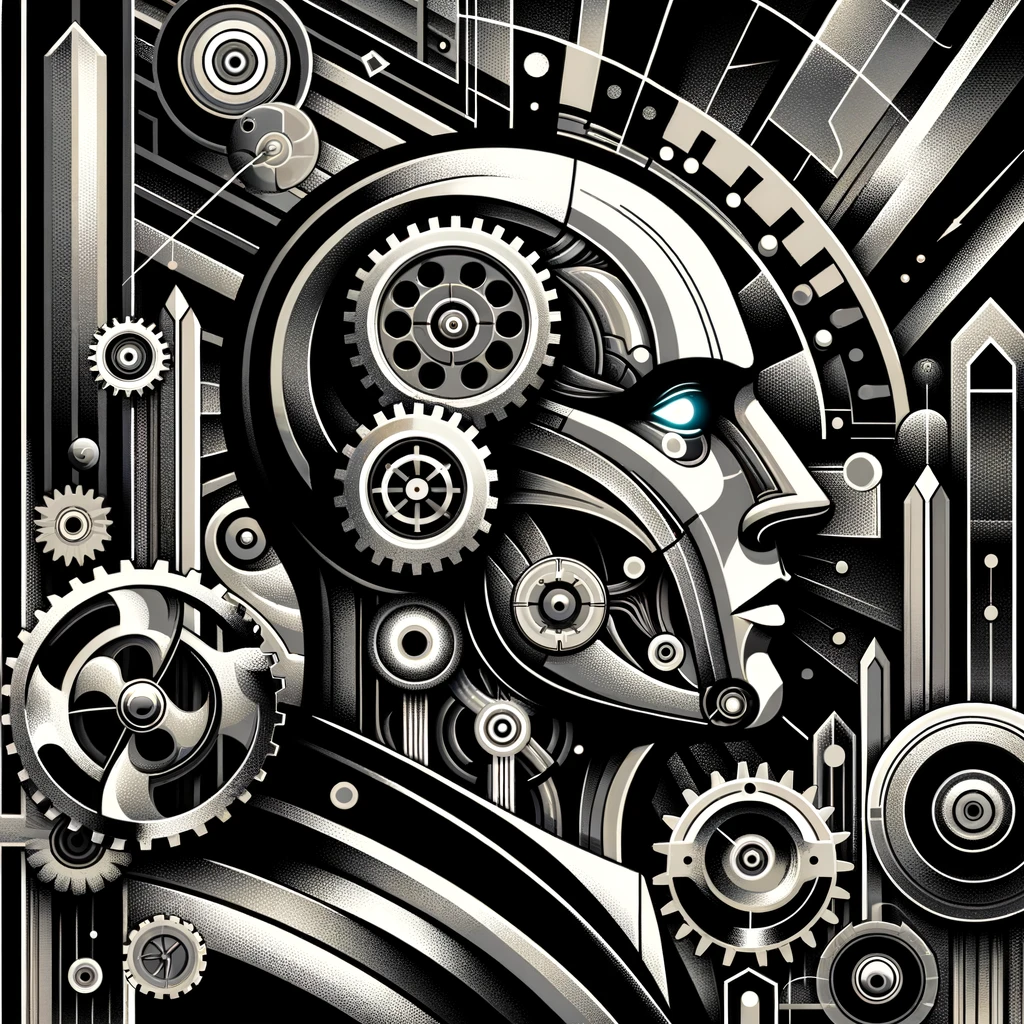
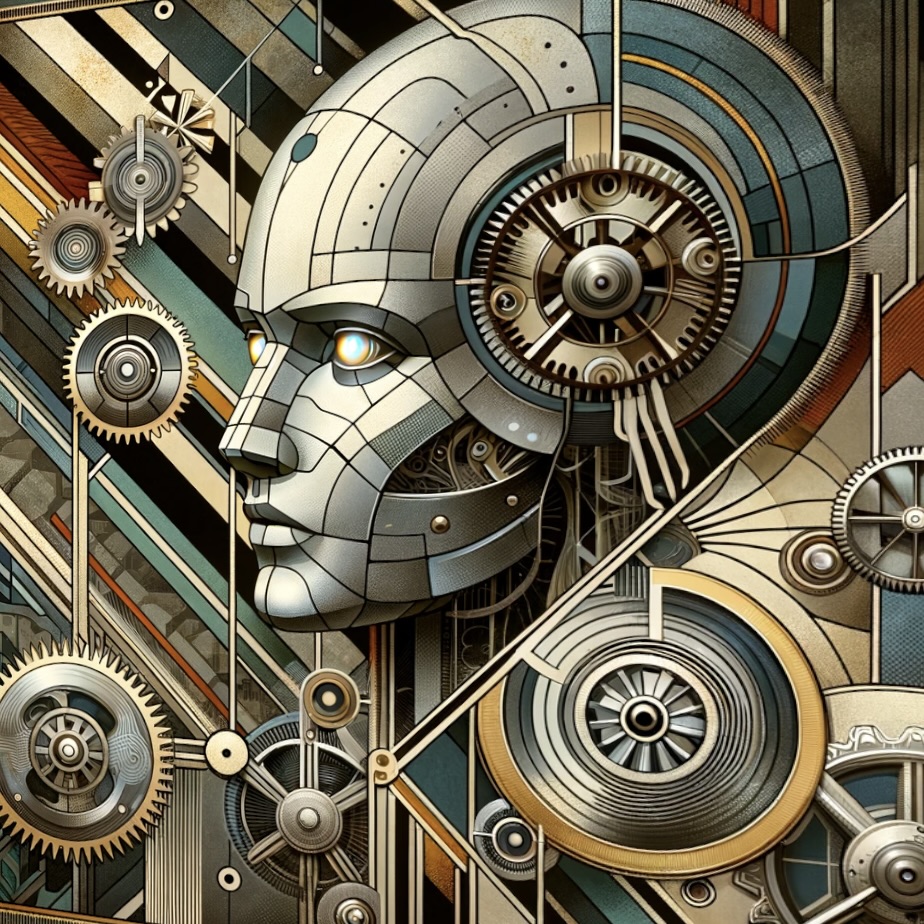
There is a complicated relationship between AI, chatbots, LLMs and humans. We’ve created these technologies and they are trained on billions of data points–human generated data points. Our words, art, music has gone into feeding these models which now are the foundation of these human-like voices that use algorithms to create new works. We can ask them to mimic specific styles and generate work for artists who are long dead. AI is perhaps the strangest iteration of pastiche in that it can’t actually be original because it has to draw upon all that already exists. AI generated content is mimicry.
However, there is a sense of permanence in this. The whole of human experience in a way captured within these AI models to be accessed and teased out by the right prompts. Is that eternity? Is that somehow, time regained?
The Magic Lantern
Aside from AI as entity this project will look at AI as a tool. Specifically as a tool to generate art. In The Magic Lantern section of this website, you’ll find a gallery of AI generated images based on passages from In Search of Lost Time. I used ChatGPT 4o to generate consolidated descriptions of key images from the novel and asked the model to then generate an image from that summary. I then used a series of prompts to adjust the image to my taste.
There are a few questions I am trying to answer here:
1. Can AI generated art elicit pleasure?
2. Whose art is this?
3. Do I get any pleasure from the act of creating this art–am I present in this work?
Thank you
Enjoy your time here. Let me know if there are anyways to improve Madeleine or if you particularly enjoyed any aspect of the experience.
Best,
Ryan Rivera

About Ryan Rivera
Ryan Rivera is a product management program director in the AI and Automation space. He is also his pursuing a Master of Fine Arts degree in Prose & Poetry with a dual-genre focus in Fiction and Creation Nonfiction at Northwestern University.
Ryan has managed corporate blogs and published several articles. His writing has also appeared in Voices (Midwestern State University of Texas) where his piece “How To Count” won 1st prize in prose, and The Cauldron (Kalamazoo College).
Ryan has a Certificate in Create Writing from Northwestern University (2021), Master of Arts with Distinction in Public Relations and Advertising from DePaul University (2013). He also holds a Certificate in Meeting and Event Management from the University of Massachusetts, Isenberg School of Management (2010) and a BA in Theater from Kalamazoo College (2001).
This project was originally conceived as. a class project for LIT 480 Topics in Comparative Literature: Proust taught by Professor Scott Durham at Northwestern University.
Click here for a full list of sources used to train Madeleine and as research for this website.