
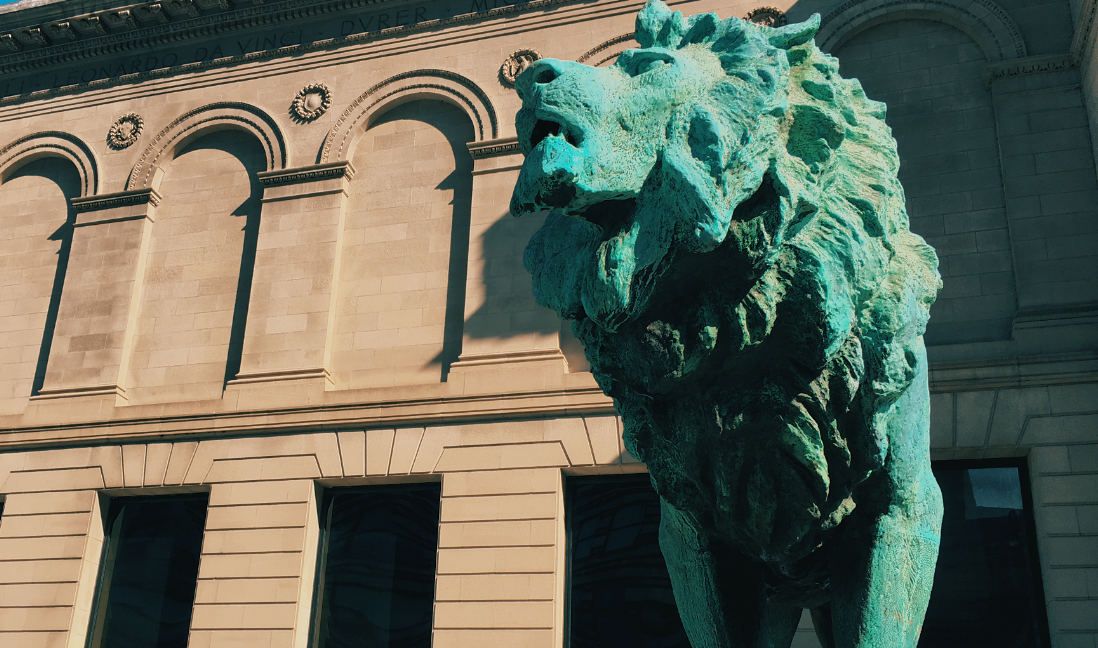
I was in one of three cramped phone booths in the Chicago office. It was the one with poor circulation, and all I could smell was the orange chicken I had for lunch emanating from my pores. The call dragged on with off-topic interjections. As it stretched past the hour, with a final “while I have you,” I started to panic. One minute, two minutes, three minutes. The call ended at six after when the person talking stopped abruptly: “Sorry, I’m getting pinged for my next call.” I shut my laptop, grabbed my notepad, and darted to my desk. I put on my tweed jacket, tucked my badge into my back pocket, and grabbed my phone. I was in front of the building in under a minute. I walked east on Monroe. I dodged people on the sidewalk, weaving between them. I jaywalked when I could, calculating the velocity of oncoming cars and the transition of lights. I crossed Michigan Avenue and reached the north edge of the Art Institute of Chicago. I was out of breath by the time I passed the two lions at the entrance. I scaled the steps, two by two, pulled up my digital membership card, and breezed through the line. I raced up to the second floor, Gallery 201: Impressionist and Post-Impressionist Painting, and there it was. A large canvas, about 7’ x 9’, filled my field of view. In the frame: several Parisians walk, sullen, on a Paris street.
That painting, Paris Street; Rainy Day, was my destination that afternoon. I arrived out of breath. I stood behind a couple of rows of people as foreign words and unfamiliar accents echoed from the glass ceiling. They took pictures, pointed, and moved on to the other masterworks that adorned the walls. I inched my way closer, finding a Ryan-sized gap in the front row. With beads of sweat on my forehead, I draped my jacket over my left forearm and undid another button on my shirt. I let my pulse begin to settle. The heat off my body dissipated into the gallery’s cool air. I interrogated the painting. I admired the rain glistening on a Paris street. Eponine from Les Mis appeared in my mind, “On My Own,” how the streets shine like silver in the painting. I thought about Gustave Caillebotte, the artist, a benefactor of the arts whose own work was largely underestimated during his lifetime. I thought about the Impressionist sense of modernity, the disruptions of factories and photography, the isolation represented in the blank faces on the canvas.
I took a deep breath, my body finally at ease, checked my watch, turned on one heel, and marched through the front door, past the lions, and boomeranged myself right back to that phone booth with poor circulation, the air still thick with orange chicken, and joined another call.
For several years, I worked a half mile from the Art Institute of Chicago. It became a habit. Three or four times a month, I’d snarf down my lunch or schedule a 30-minute afternoon block and bolt to the Art Institute. I’d look at one or two pieces, contemplate for a few moments, and then I’d hoof it right back to the office, the beneficiary of proximity and a membership card. Some days I had a target in mind, a craving for a specific work. Other days I’d be in discovery mode, exploring galleries at the edges of the museum. There were days when I’d have a piece in mind only to be pulled toward the unexpected, a surprise, a delight. Those walks cleared my head, untangled knots, and as a bonus I got in 2,000 extra steps.
I could’ve circled the block or walked along the river for a breath of fresh air, and on many days I did. But on Art Institute days, I needed something more: a moment of close attention to an observation made by someone in a world not my own.
Art is an artifact of someone else’s attention. My perspective mingles into the artist’s point of view. The scrutiny of light against brick, the whisper of a brushstroke capturing a cloudy sky, become a teleportation device. My body responds to the tension Caillebotte imbued into his painting. In that gallery I stood in three places at once: in a crowded room; America in the twenty-first century—with all of its preoccupations with AI and war; and through Caillebotte’s eyes, Paris in the nineteenth century—with all its preoccupations with industrialization and, well, war. A moment refracted through experience and time.
Paris Street; Rainy Day is an encompassing work that pulls me into its scene as though I were passing the couple in the foreground on the street. There is something in it that helps me see my own world through a different lens. Proust thought a book was an optical instrument with which to examine your own existence. A painting offers the same opportunity. Something external that reveals the internal.
The lens before me that afternoon depicts a scene in which everyone is moving. Men in top hats with bow ties holding gray umbrellas tilted against the rain. A woman in a fur-trimmed coat, hair piled atop her head. All focused on wherever they needed to be next. No eye contact. No connection. A funhouse reflection of me in that gallery, my brow sweaty from my dash across the Loop. The irony is not lost on me. I left a building full of colleagues, trotted down a busy Chicago street, not connecting to anyone, dodging people and cars, just to arrive in front of a painting depicting much the same thing: a world in which we are oddly isolated on busy city streets. But for a moment in that gallery, I was not alone; I was communing with Gustave Caillebotte.
Proust gave me a way to describe the relationship I held with Caillebotte in that instant. In Swann’s Way, the young narrator sends a note down to his mother, and as he imagines her reading it, the physical distance between them falls away and “an exquisite thread” binds them. His words in her head. I felt that way about Caillebotte: his image, his attention, in my head, an exquisite thread connecting us across nearly 150 years.
In that phone booth, my laptop open to a mosaic of familiar faces, I looked at my tiny square and saw that I was the cat that ate the canary. A sly grin on my face concealed a secret: I had been changed. Not in any truly life-altering way, just renewed. Proust wrote that habit calcifies us, puts our senses to sleep. But I had broken the rhythm of my day, been transported to another time and place, and felt connected to a world beyond spreadsheets and deadlines and jargon. I had given myself nourishment that I couldn’t find in the lunch line. I finished my day with vigor, newly aware that the stress that weighed on me all day wasn’t as consequential as I had led myself to believe. Suddenly, decisions got easier. The work more manageable.
Today, a few years later, I’m sitting on a New York rooftop, and my legs still remember it: how they propelled me forward, how they carried me to the right gallery on instinct. I still go to museums to refill myself, but rarely have to squeeze a visit into a 30-minute break. These words are my own piece of art, an artifact for an audience to discover. I won’t see you read it. I may never know that you did. But the thread holds regardless. It runs from Caillebotte to Proust to me to you. An exquisite thread across time.
Leave a Reply