
“AI passed the LSAT. AI won a writing prize. AI can out-code most early career coders. AI, AI, AI! AI is better than you. You should probably get a job in healthcare. Just not radiology, AI is really good at that.”
The advancements—never ending. The psychological toll—immense. Can I stay ahead of AI long enough to retire?
A couple of years ago, I saw The Antiquities at Goodman Theater in Chicago. The premise of the play: a dystopian future where artificial intelligence has curated a “Museum of Late Human Antiquities” in an effort to understand the human experience. The same way we’d go to colonial Williamsburg to understand early American life. The central question of the play asks “what does it mean to be human?” And seeks to answer that question by moving through vignettes and exhibits, each highlighting something uniquely, delightfully human. I can’t help but feel I live in one of those exhibits, one meant to illustrate fear. Or more accurately, apprehension, that very human emotion of skepticism and distrust.
I’ve grappled with this question, “what does it mean to be human,” long before OpenAI, Google, Anthropic, and all the other frontier labs upended the species. Back then, the question centered on identifying a higher purpose. It was philosophical and hopeful. Now the question feels centered on justifying our value, our worth as a species. This feels much more existential than philosophical and the stakes much more dire. All over the news reports of AI models doing something once thought distinct purview of humanity. So much so, that is what we called them—The Humanities. But now AI can write. AI can create images. AI can code. It can draft legal arguments, generate a feature-length film, tell a joke. Every advancement a threat to a particular passion or career.
As Generative AI was rising I was working in tech as a product manager and marketer; I was in school working on my Master of Fine Arts degree in Prose and Poetry; I had aspirations to one day teach at the university level. All of those things felt suddenly trivial and under threat. AI cast a shadow over every aspect of my professional and creative aspirations. AI can do it faster. AI can do it more consistently. AI can do it more intelligently. My years of experience, my education, my value chipped away, erased with every model update and replaced with em dashes (which I still use even if it signals AI generation—they come in handy and I’ve used them long before ChatGPT) and overly familiar platitudes.
So, I did something very human: I went into survival mode and began to search for an advantage. A footing in the quicksand. In this search I found that I was a lone individual fighting against an omnipresent, all knowing entity that was absorbing the whole of human knowledge. How could I compete against something that was not only consuming everything humanity had ever done but was also already devouring me. Because like many other humans, I embraced AI to keep competitive, and with every upload and prompt was ceding my moat to my conqueror.
I am not an AI catastrophist. On the contrary, I have spent a good deal of my career helping to further AI adoption. I believe it has unimaginable possibility to transform society for the better. But my eyes are also open to its downsides and my lizard brain is sounding the alarm bells. This is a threat.
“Danger, danger Will Robinson,” screams the AI robot in Lost In Space. Here I am, lost on Earth. Each AI hype cycle brings another round of lay offs, signaling more doom and gloom. I remember the first time I tried ChatGPTs 4o model. It felt leaps and bounds ahead of the previous iteration and as I explored and experimented my wonder and awe melted into anxiety and potent sour waft of stress sweat. ChatGPT is now a Phd level psychologist. Gemini can solve the unsolvable math problems. Claude is as eloquent as a poet laureate. The progress is relentless and my hopes sink like a lead balloon in its stream. How would I ever make my mark? I’m singular. I’m finite. I’m just me, sitting at a computer or on my phone trying to out create something on every phone, every computer. It was in that oh so human despair of irrelevance that I found a glimmer of hope. We are singular. We are finite. We exist in our perfectly limited context. A lens that can’t be recreated. An idea sparked in me and a smile widened on my face. I closed my lid on my Mac, opened the window, and let the crisp Chicago evening air fill my lungs with calm.
This limitation is our allure. Because even in an age of AI agents, humans need to coax truth out of the model. The hallucinations of the model require a human lens to adjudicate its worth. Because ultimately it is still humans who are the consumers of the output. And it dawned on me that consumption takes time and we get to choose however we want to spend it. Time is limited, we need to work, we need to sleep, and ultimately we die. Our time comes to an end. And because of this finiteness, our time is valuable. A luxury not afforded to AI models.
Our biggest strength as humans is our tenacity in the face of mortality. Our need for relevance and to leave a mark on the future. It is rooted in our DNA and the course of human evolution. It is evident in the artifacts that trail us long after we’ve died. Our physical lives are limited so we create, build towers and monuments, innovate to prolong our existence in some way or another. We procreate. That is the human power: scarcity, limits, finiteness.
I mentioned context. AI models are generally trained on billions upon billions of data points. All of human knowledge consumed, crunched, and predicted. They inherently lack context. Humans have to supply that. Humans have to provide the point of view. The problem at hand. The framing. Humans exist in context. The exhibits in the “Museum of Late Human Antiquities” can’t tell the human story without it. And that is because our bodies move through a physical world. We string together moments of time allowing memory to color every thought, every action. I hear a line from Romeo and Juliet and can remember how I delivered that line my senior year of high school and how hot my costume felt underneath the lights. Sweat streaking my powdered face as I went in for a kiss.
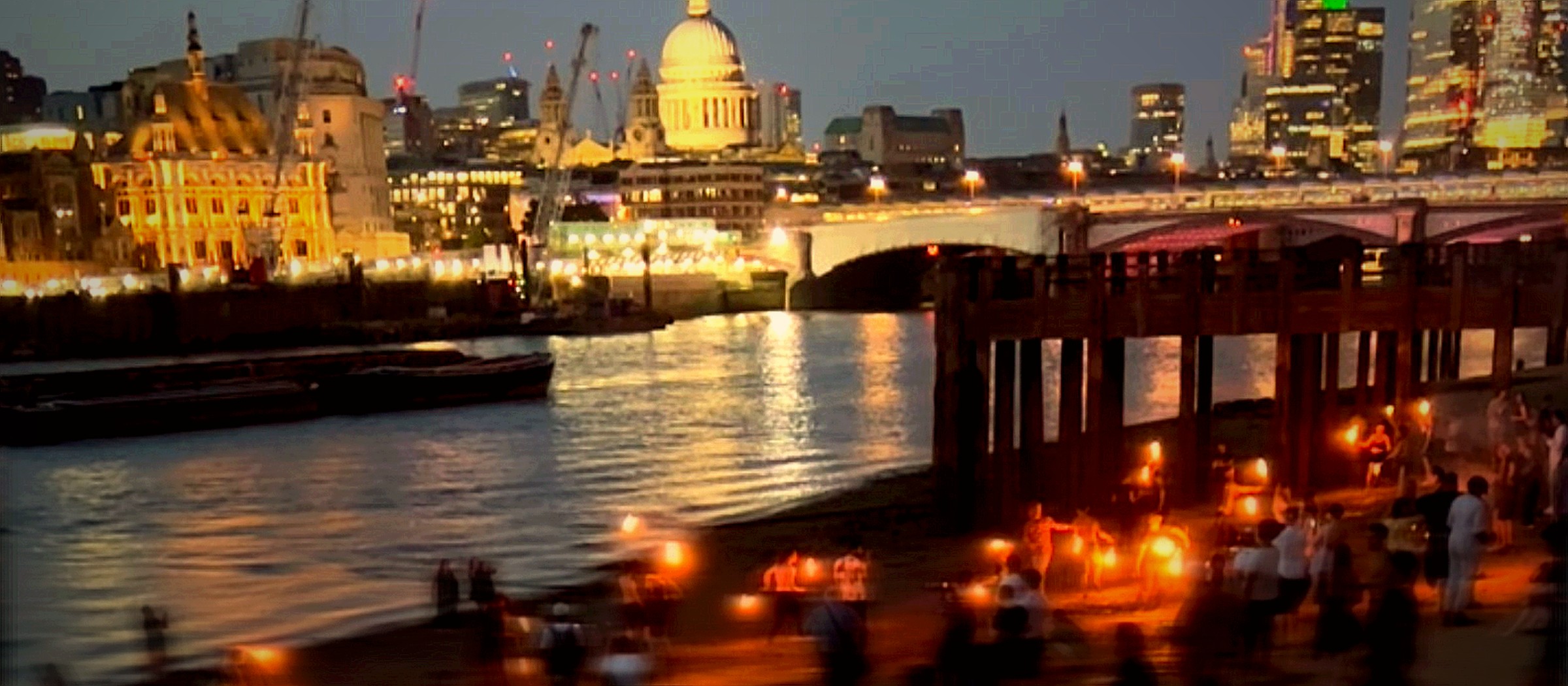
Taking a sip of tonic water now and suddenly I am in 2022 drinking a fizzy can of Gin and Tonic while watching King Lear in 90º weather in Shakespeare’s Globe. Feeling the lack of air conditioning soak my white linen pants. I remember leaving early and spotting a group of ravers twirling fire on the banks of the Thames. A model might be able to recreate that scene with a few prompts from me, but it is unlikely that it would reconstruct that particular occasion on its own, even with a couple prompts. No, it requires my human body, tipsy and hot, leaving a Shakespeare play after the second intermission and wandering along the river hoping for gust of wind off the cool water. I can feel the relief and the awe as the air cooled and the sun set, fire from the twirling torches flickering against my eyes. Existing in that specific, fleeting context.
Since that day on the banks of the Thames, life has moved on. My context has shifted, technology has advanced, and AI is now ingrained into my work, permeating, to some degree, most aspects of life. The question becomes: do we let AI shackle us to the work, or does it free us to feel the setting sun against our skin?