
On Washington Square Park, Delphi, and why identity rarely resets in one clean break — it layers, like a city built on itself.
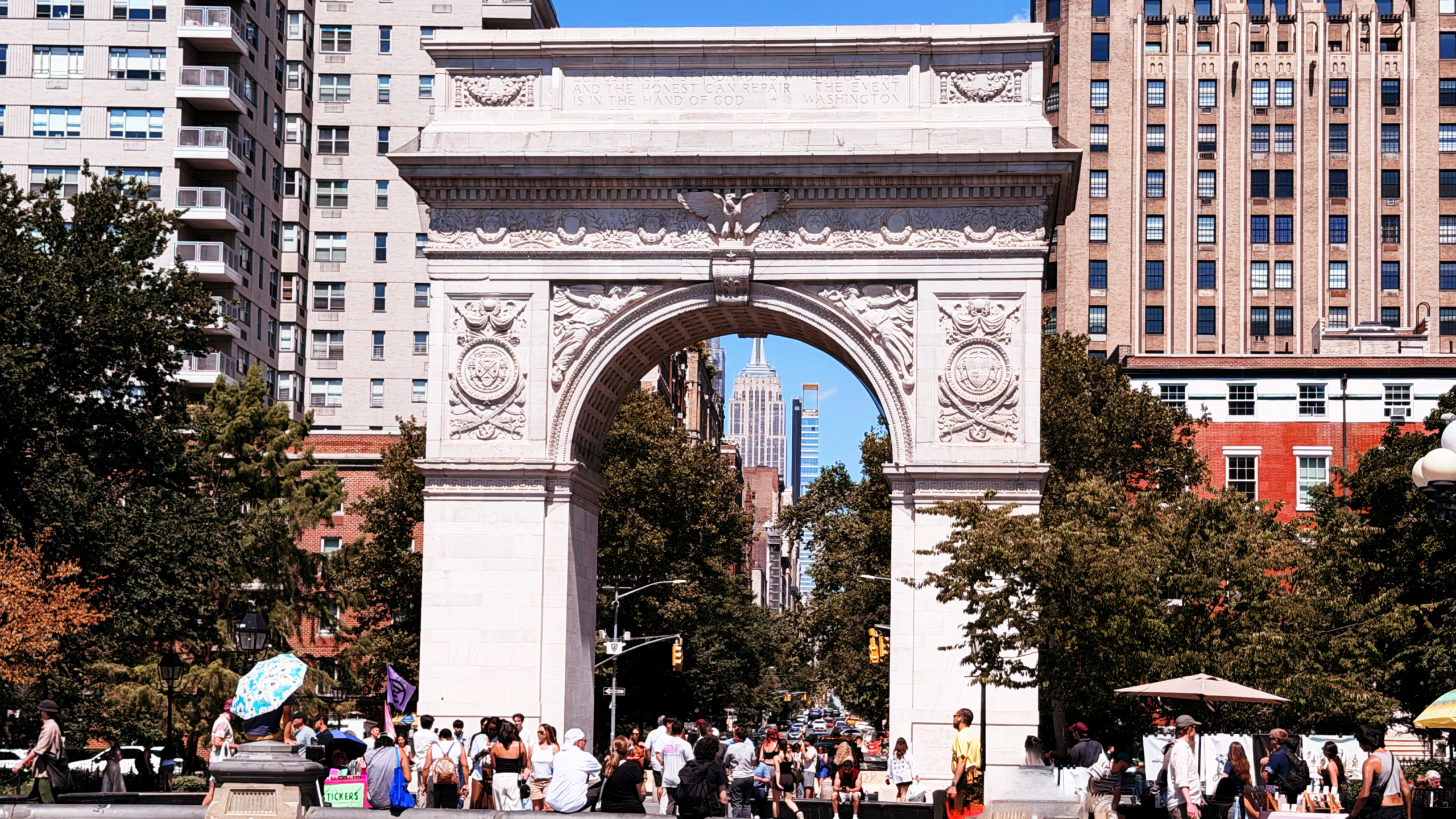
The arch on the north end of Washington Square Park looks like a portal to the past, a marble time machine looming over the park with grandeur. That park, that arch, I’ve romanticized its history and bohemian ethos. I imagine a jazz clarinetist playing Rhapsody in Blue, beat poets snapping their fingers in approval, hippies conducting a sit-in to protest the war. The park comes alive for me as an emblem of rebellion and new ideas.
Once I breach the park’s threshold I am transported. Directly ahead of me a man sits on a stone pedestal protruding from the edge of the dry fountain. He has a vintage box camera set up but the illusion is betrayed by a Venmo QR code at his side. Contradictions litter the park. Etch-a-sketches with intricate designs sit next to digitally generated art. A man holds up a sign that reads “Philosophy Chat Spot” which feels like a remnant from the park’s intellectual past, but in front of him a MacBook reflects the hot afternoon sun. I turn the corner and there’s a man sitting at a table, “Tarot by Kyle”, who I presume to be Kyle, scrolling his phone while he waits for someone to ask for a reading. A park musician with a clarinet, clad in suspenders and a top hat, is interviewed by a social media influencer. There are chalk-artist activists making a ruckus but they aren’t calling for an end to a war. They’re asking pointed questions about AI, inviting passersby to write postcards to “our future AI overlords.” I try to muster a thought:
Dear Bubba (I don’t know why our AI overlord would be named Bubba),
Greetings from 2026. IT IS BONKERS. If you have any pull, can you spare me from the apocalypse? Best – Ryan
I don’t pin it to the board or read it to the crowd. I slip it into my back pocket. Wouldn’t want a record for Bubba to see.
I think I keep waiting for the switch to flip. Like there is going to be a specific demarcation between the past and the present. The before and after photos of a world teetering on the edge of the AI revolution. All around me I see signs of the future arriving, but in the same frame I also see anchors to the present and the past. Totems that tether me to the history of humanity.
In the summer of 1999 I was twenty years old and on my first trip abroad. It was a program for students to study theater where it started, Greece. On days we didn’t have rehearsals for The Birds and Medea, or class, we’d take day trips to see historic sites. I remember being in Corinth and thinking about Paul’s letters. I saw the Tomb of Agamemnon at Mycenae and had flashbacks to reading the Oresteia. Historical sites are like olive trees; they abundantly dot the Grecian landscape.
Nothing, though, felt quite like Delphi. High in the mountains overlooking a mist-covered valley, I sat holding a stone, smoothed by millennia of exposure, in the palm of my hand and luxuriated in the feeling of smallness the site engendered. At the Temple to Apollo, the mystery of this site welled up around me. The ancient structure whispered to me from the past, an echo of the Oracle’s enigmatic warnings and prophecies that served as fuel for so much tragedy. Someone once told me Delphi is the bellybutton of the universe. Sitting on the edge of the ruins, I was tethered to a higher being—a baby still attached to its mother by umbilical cord.
The ruins of Delphi are exposed, or should I say excavated, so the connection to the past feels distinctly immediate. It hasn’t been buried under centuries of human progress like so many other sites. Sitting there the modern world felt far, far away.
In Athens, Greece’s history protrudes from the earth like temporal outgrowths. The Acropolis and its monuments sit nestled next to hotels and office buildings. Motorbikes and taxis whiz by on ancient paths. Antiquity and modernity collide in a mosaic across the city. Athens has been many things in its history: the Acropolis itself has been a temple to Athena, a Christian church, a mosque, a store for munitions, ruins, and a museum. Each one augmented, not erased.
I see this every day in New York City. Glass towers climb to soaring heights next to centuries-old edifices, streets that follow colonial Dutch property lines or ancient indigenous routes. Repurposed warehouses get a new life as luxury co-working spaces. But it isn’t just the physical structures that are transforming—the work going on inside of them is shifting, too. From physical labor to knowledge work to whatever emerges on the other side of the AI revolution, something new is taking shape and it is moving in next to the older structures we’ve already established.
I’ve searched for hard stops. Reset buttons. Rebirths. Scorched earth. Pompeii and Herculaneum—catastrophic change. A layoff, a move, the end of a relationship can all feel apocalyptic. The world as you know it coming to an end. But it is rarely that dramatic or even that lasting. We seldom experience true ruptures in our lives. Setbacks, stumbles, sure. But we don’t often break apart in ways that require a factory reset or even a hard reboot, to use the language of tech. What we view as our intrinsic identity is often just a context that only defines an application of our talents, not the enduring structures holding it up underneath.
Over the last couple of months I’ve been wrestling with this. The Monday after I parted ways with my last company was a shock. I had an overwhelming sense of relief but the obvious fears were stuck in my throat. No plan. Just an empty calendar. The stress-induced bile burning in my chest. It is hard to step away from a way of living. It felt like Vesuvius erupted and spewed ash all over my life. But like Pompeii, even destructive occurrences can serve as a mechanism of preservation. I reminded myself that I wasn’t starting over. I looked at that blank calendar and started to fill it in with choices and not edicts. Since then I’ve rediscovered talents and skills I’d buried because they weren’t relevant to my day-to-day work. I’ve embarked on projects that force me to rely on what I’ve learned from my years in tech, and to dig back into my background in theater and creative writing. I feel like I am living a life less like Pompeii (buried for centuries) or Delphi (preserved on a mountaintop) and more like Athens: a mosaic of my former selves coexisting to make something new.
Walking around Washington Square Park, I focus on the couple feeding pigeons, the man sunning his belly while reading the New York Times. I see a tourist framing their children in front of the arch. An NYU student reads Kafka on a bench as the smell of marijuana wafts by in clouds. Chess players hustle for their next match. Instead of telling Bubba how out of whack the world feels right now, maybe I’d tell Bubba about Washington Square Park and how it serves as a temporal collage. The people in the park could be of any time, but here they are today. Years ago I wrote an essay titled “Versioning.” In it I cataloged past iterations of myself like discrete software releases. As though each transformation was a new build from the ground up. I was silly enough to think that perhaps I had arrived at some plateau—optimized. But the truth is, I’m ready to write “Versioning 2.0.” I’d like to change the primary metaphor from versions to mosaic. Each iteration of myself not replacing the preceding, but sitting amongst them. Working together to make a clearer image.
Comments
2 responses to “No Hard Stops”
Oh Ryan, you blow me away. Your words are like music and the visions they supply do take you to ancient lands. I feel I know you now even a little bit better, and I’m so proud you’re part of my life. Godspeed, as you travel your new pathway.! ✝️💟
Oh Ryan, you blow me away. Your words are like music and the visions they supply do take you to ancient lands. I feel I know you now even a little bit better, and I’m so proud you’re part of my life. Godspeed, as you travel your new pathway.! ✝️💟