
The painting hung before me. At nine by seventeen feet, its presence dominated the room and its scale enveloped my attention. I sat on a bench in the gallery and let the chaotic splatters and kinetic streaks pull me into Jackson Pollock’s world. I was on the fourth floor of MoMA, sitting next to an older gentleman wearing a black T-shirt with gray and white checked suspenders and a young woman. She had a blank sketch pad and a pencil in her hands. She tilted her head from side to side, then put down her pencil without making a mark. Inscrutable.
In the silent room, a rare occasion at the museum, my mind worked to untangle the crisscrossed layers. When I thought I’d found a plane, a layer, my eyes crashed into another incomprehensible cross. Like peering into a bowl of spaghetti and trying to form a coherent image from a cross-section. After a few minutes the edges of the painting gently oscillated in the periphery, making the entire painting feel like the canvas was rolling in waves.
I felt as though I were moving through Pollock’s neural network. That he’d been able to capture the architecture of his brain, the connection between neurons and axons, the chemical signals and electrons jumping from one dendrite to another. It made my own synapses spark with alternating surges of curiosity and excitement. Had I come to an understanding with Mr. Pollock at last?
I sat with the mental and physical discomfort of the moment. My shirt was wet with sweat from my walk through the New York summer heat so the air conditioning had an outsized effect on my skin, making it bristle with goose bumps. I focused back in on the painting, re-submerging my mind to connect to his. I teetered on the edge, engrossed in the work but also aching to check my phone. Decades of corporate life had taught me that staring at a Jackson Pollock painting at 3 PM on a Wednesday afternoon is not productive. I itched to open my phone, scan my email, check social media. I thought I could back-door my way into a dopamine hit by taking a picture, but I knew the second my phone unlocked my fingers would instinctively dive for a quick fix. Tap, Instagram. Tap, LinkedIn. Tap, NYT.
I resisted and embraced the sensation; I let the urges pass through me like phantoms of a desk-bound life. My objective was to observe the painting, experience it in a way that a hurried walk on a busy weekend doesn’t allow. To give it my undivided attention. I cycled through moments of calm and an excruciating anxiety that I should be either producing or consuming…something.
I had arrived at the Pollock purely by accident, through a coincidence of changed plans and a need to replenish my energy after several days of sustained work. Because I was no longer running on someone else’s clock, I decided to spend the afternoon at The Met. I changed clothes and started walking up Fifth Avenue. It was crowded with tourists and late lunchers, so I diverted over to Madison. I left my headphones off and let my brain process the threads I’d left dangling from the morning’s work. I observed the store windows and passersby, with sirens, jackhammers, impatient car horns, and polyglot pedestrians providing the soundtrack.
Eventually, my shoulders receded from my ears and the thoughts of my work started to melt away in the summer heat. I started to plan my visit to The Met. Would I go to the Europeans? Maybe the American wing? Or lose myself in the statues and carvings of East Asia? I stopped for a bottle of water around Fifth and 70th. The vendor there was slamming the lid to his ice bin in a staccato beat to the music that played on his radio. My mind was generally blank as I approached the member’s entrance and discovered a sign informing me the museum was closed on Wednesdays. First: disappointment. Then: frustration—how I’d wasted nearly an hour of my day. Finally: acceptance—So what?
A walk in the park is just as nice as a day at the museum. So I pivoted and entered Central Park just uptown from the museum. I sought out paths I hadn’t taken before while avoiding steep climbs as much as possible. I’d already walked two and a half miles in the heat and didn’t need to add elevation. The park was littered with people. On one of the great lawns, dozens of people sat on beach blankets sunning themselves. People on park benches reading books or catching up with old friends. Slow and calm. Joggers kept a steady pace on the running path, bikers whizzed by with no sense of urgency. “Why aren’t these people at work?” I thought. Corporate judgment crashing into the idyllic scene.
At this I caught myself. I rewound and gamed it out. Here I was deliberately taking a break from my work. Which, even when I am working, I am no longer “on the clock.” I’m building something. I’m working on something for myself. I have had this idea of productivity: that time is money. How much I need to produce, how much I need to optimize my time. What didn’t occur to me though, was that what I was doing, choosing to take a breather, was just as productive but in a different form. Sure, a hard one to describe to someone else, but I am learning that I need to reframe productivity or maybe even expunge it from my operating system altogether. And that even if it doesn’t look like a PowerPoint, email, or shipped feature, or doesn’t produce at all—that it is still valuable.
These thoughts carried me until I’d reached the downtown edge of the park. I pivoted again and made my way to MoMA where I encountered the Pollock. It opened me up, sitting there. Untangling the noodles of paint thrown across the canvas. I moved to other galleries after filling up with One: Number 31, 1950. I went to the fifth floor and walked through the Duchamp exhibit. I followed his work through the galleries as his brilliant early paintings morphed from representational pieces with vibrant colors and human figures, to his cubist work with shadowy forms and somber hues, and finally to his readymades—which simply exist in new context and paved the way for someone like Pollock.
After Duchamp I rode the escalators down. As I was lowered from floor to floor, I considered how Duchamp’s work seemed to shed its skin with every evolution. What started as representational paintings relinquished the constraints of the literal. Once free he explored time and movement through cubism. Then, in a stroke of pure audacity, he shed the canvas itself. He used his found objects—the bottle rack, the urinal—to shatter what the accepted definition of art could be.
Similarly, I am unlearning what the last twenty years of corporate life taught me about productivity. The canvas of a filled calendar, shipped feature, or launched campaign isn’t the only way to measure time well spent. Even rest, which I once viewed as the antithesis of productivity, still had to prove itself useful as a mechanism to do more work. Otherwise rest was something to feel guilty about. Everything in service of output.
It is a hard habit to break. To feel comfortable sitting quietly, staring at a painting with no added weight to the experience. To contemplate that a Wednesday afternoon did not need to justify its existence. What if attention, pleasure, curiosity, and enjoyment required nothing but to just be felt?
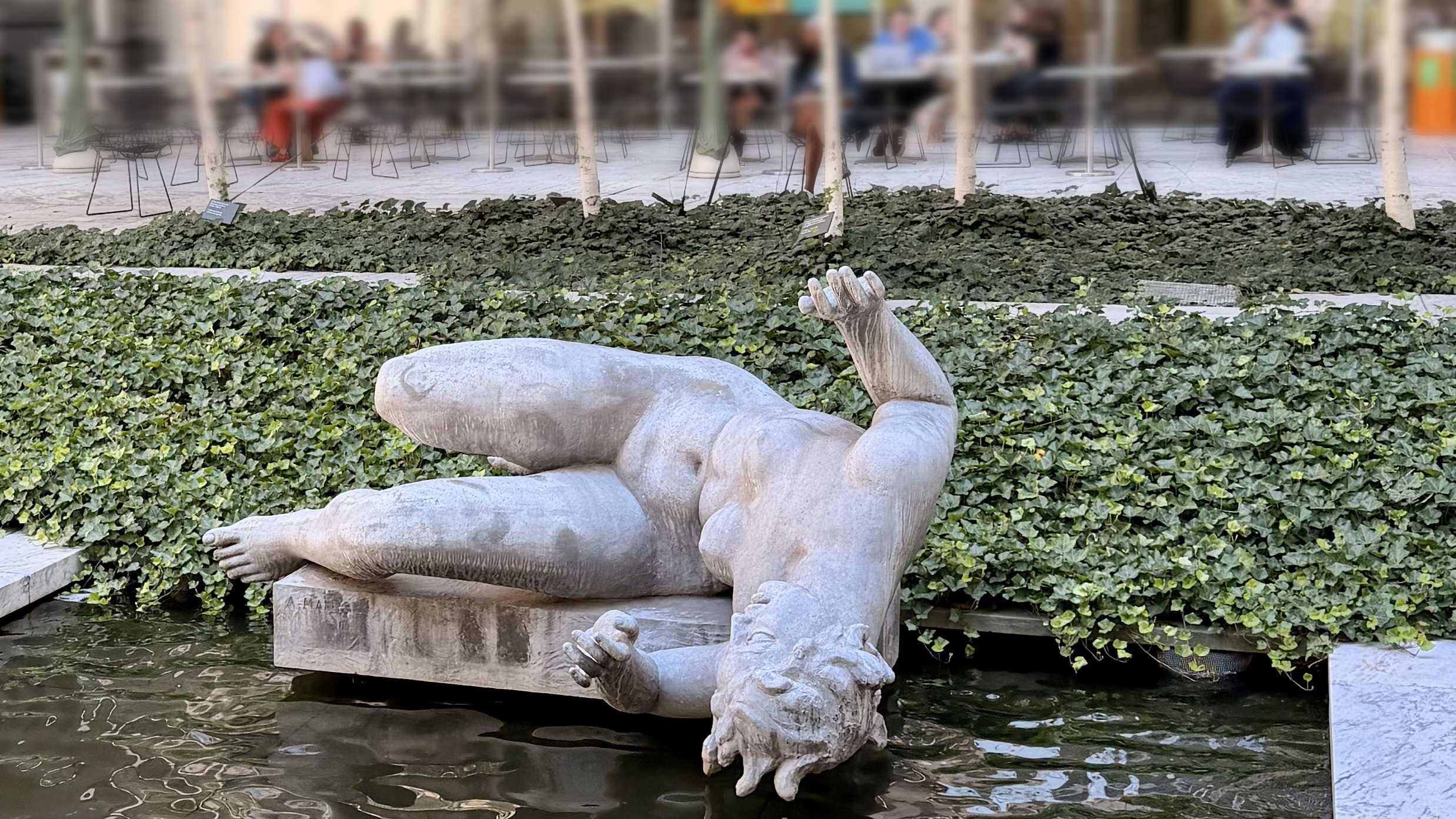
I arrived on the ground floor and made my way out to the sculpture garden. I sat there listening to the water from fountains trickle around me. I observed groups of people making plans for the rest of their day, talking about art, connecting to each other. I ordered a glass of chilled rosé and took out my phone. I casually recorded a few observations and ideas that had surfaced throughout my meandering afternoon in a note. No tags, no assignments, no to-dos, no next steps.
The feeling of depletion I’d felt earlier, the exhaustion that prompted the pause to begin with, was gone. I was full, rehydrated. But even if I had still felt tired or a little drained, that wouldn’t strip the afternoon of anything. I had been present. And that was enough.

Leave a Reply